
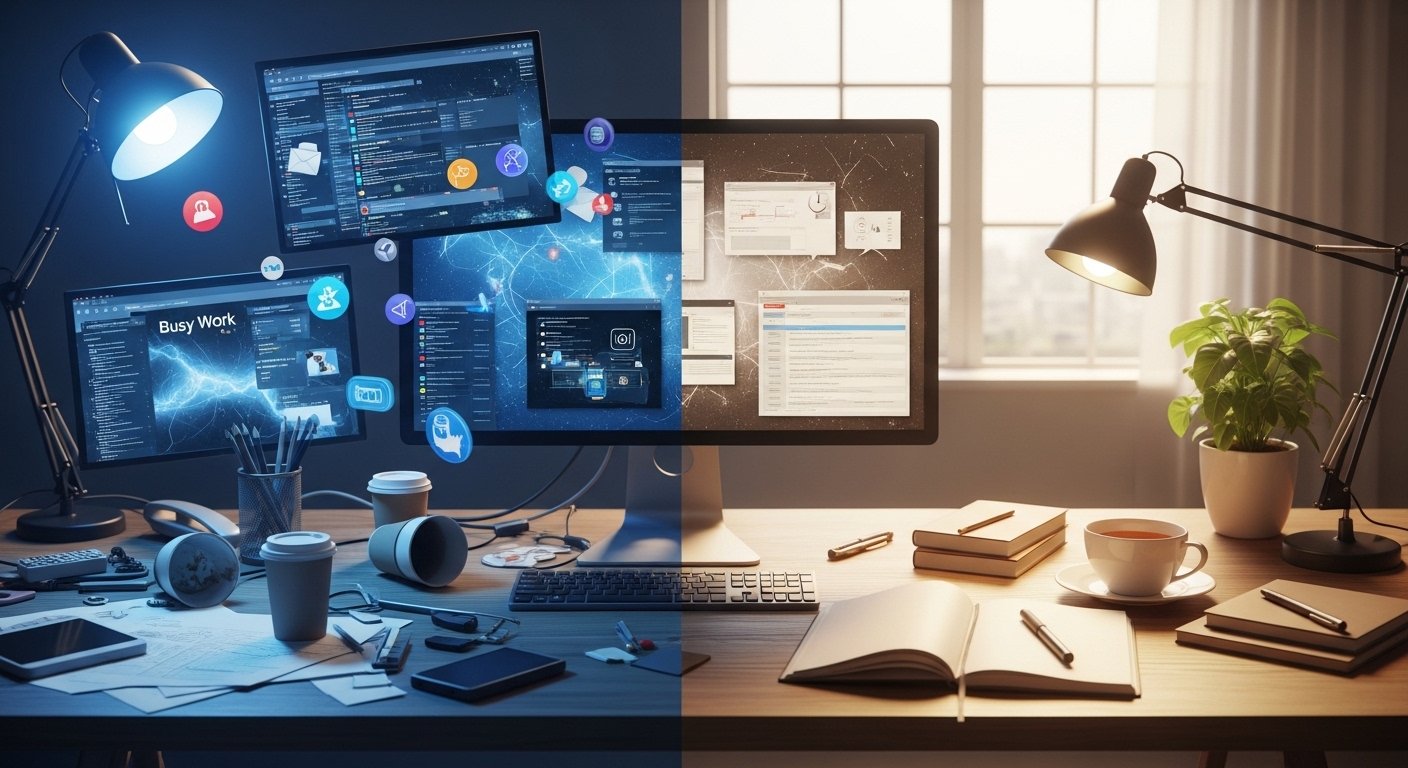
A sculptor in her Karachi studio checks her phone for the third time in ten minutes. Notifications from collaborators, gallery updates, and a dozen group chats pull her away from the clay. By evening the form she envisioned remains untouched. Across continents, a Nairobi activist drafts campaign notes between back-to-back meetings and endless email threads. The strategy that could shift policy sits unfinished. These moments repeat in creative lives everywhere: the quiet erosion of focus that leaves meaningful work half-done.
In fields where ideas must ripen slowly, busyness has become a default mode. Yet the difference between deep work and busy work determines whether art moves people, whether activism endures, or whether thought simply circulates without impact. The tools exist to shift the balance. Time management tips for better productivity are not about doing more. They are about protecting the kind of attention that creates lasting cultural value.
The attention economy has intensified the problem. Digital platforms reward constant availability while creative and activist work demand sustained, uninterrupted presence. Post-pandemic shifts toward remote and hybrid arrangements blurred boundaries further, turning many studios and organizing spaces into perpetual open offices. At the same time, artificial intelligence promises to handle routine tasks yet often adds another layer of shallow coordination. The result is a widespread sense that we are working harder while achieving less of what truly matters. Historical creators understood this instinctively. Maya Angelou rented a hotel room solely for writing, free from domestic distractions. Beethoven followed rigid morning rituals to enter a state of concentrated composition. Their practices echo what modern research confirms: most people manage only three to four hours of genuine deep focus in a day, yet many spend the majority of their working time on low-value activity.
What Deep Work Really Means, and Why Busy Work Feels So Rewarding
Deep work, as first articulated by Cal Newport, is professional activity performed in a state of distraction-free concentration that pushes cognitive capabilities to their limit. It produces new value, improves skills, and is hard to replicate. Busy work, by contrast, consists of logistical, non-cognitive tasks, emails, administrative loops, and digital maintenance that create the illusion of progress while delivering minimal lasting impact. The brain prefers busy work because it offers immediate dopamine hits from completed checkboxes and visible activity. Deep work requires discomfort and delayed gratification. For creatives and thinkers, the cost of choosing the latter is steep. Context switching, the mental tax of jumping between tasks, can consume up to forty percent of productive capacity. The result is higher cognitive load, shallower ideas, and eventual burnout that silences the very voices society needs most.
Prioritizing What Matters: The Pareto Principle and Eisenhower Matrix in Practice
Two classic frameworks help creatives cut through the noise. The Pareto Principle, often called the 80/20 rule, observes that roughly eighty percent of results come from twenty percent of efforts. In artistic practice this might mean that twenty percent of compositional choices or color decisions determine eighty percent of a work’s emotional resonance. For an activist, twenty percent of outreach strategies may generate eighty percent of movement momentum. Identifying that vital twenty percent frees energy from the eighty percent of tasks that yield diminishing returns.
The Eisenhower Matrix adds clarity by sorting tasks into four quadrants: urgent and important, important but not urgent, urgent but not important, and neither. Creatives often discover that gallery deadlines fall into the first quadrant while social-media posting lands in the third. The matrix encourages scheduling important but non-urgent creative time first, delegating or eliminating the merely urgent, and removing the rest. Applied together, these tools transform vague ambition into deliberate practice. A writer might realize that morning drafting sessions produce the bulk of publishable pages while afternoon administrative work rarely advances the manuscript. Protecting the former becomes non-negotiable.
Architecting Focus: Time Blocking, Task Batching, and Workflow Optimization
Once priorities are clear, structure follows. Time blocking carves the calendar into dedicated segments for specific work types. A visual artist might reserve uninterrupted mornings for studio practice, afternoons for correspondence. Task batching groups similar activities, answering all emails in one ninety-minute window rather than scattering replies throughout the day. These practices reduce context switching and lower cognitive load. Workflow optimization then refines the system. Simple audits reveal redundant steps, duplicated communications, or tools that complicate rather than simplify. The goal is not rigid control but a flexible scaffold that supports flow. Many global creatives adapt these methods to local rhythms. In cultures that value relational time, batching might include community check-ins before deep creative blocks, honoring both connection and concentration.
Energy Management, Atomic Habits, and the Real Drivers of Procrastination
Clock-based schedules alone cannot sustain creative output. Energy management recognizes that human capacity fluctuates with circadian rhythms, nutrition, movement, and rest. Some artists produce their sharpest work in the quiet hours before dawn; others find clarity after midday prayer or an afternoon walk. Atomic Habits, James Clear’s framework of small, compounding behaviors, builds the infrastructure for these peaks. A single sentence written daily compounds into finished manuscripts. A five-minute studio warm-up ritual eases entry into deep work. These micro-habits quietly rewire procrastination triggers. Perfectionism, fear of judgment, or unclear starting points lose power when the next action is absurdly small and repeatable. Over time the system itself becomes the source of momentum.
Deep Work Across Cultures: Beyond Western Efficiency Narratives
Productivity conversations too often default to linear, monochronic time orientations common in parts of North America and Northern Europe. Yet many societies operate with flexible or polychronic understandings where relationships and context shape when work happens. In parts of Latin America, the Middle East, and South Asia, meaningful progress may emerge from extended conversations rather than tightly scheduled blocks. Effective time management tips for better productivity therefore require cultural intelligence. An Indonesian collective might weave deep creative sessions around communal meals. A Mexican artivist could use siesta rhythms to recharge before evening strategy meetings. The universal principle remains: protect space for undistracted thought. The delivery adapts to local realities. Mindfulness traditions from Buddhist, Sufi, or Indigenous practices further support focus without framing it as individual optimization. They remind us that sustained attention serves collective imagination as much as personal output.
From Distraction to Contribution
The shift from busy work to deep work is ultimately an ethical and cultural choice. When creatives and activists reclaim their attention, they produce work that challenges power, reimagines community, and sustains long-term movements. Superficial activity may fill days but rarely changes them. The quiet power of focused effort, however, ripples outward. A single novel written in protected morning hours can reshape public discourse for decades. A campaign strategy refined in distraction-free blocks can alter policy for generations.
None of this requires monastic isolation or privilege. It asks only for intentional boundaries, honest prioritization, and gentle persistence. The tools, Pareto Principle, Eisenhower Matrix, time blocking, task batching, energy awareness, atomic habits, are accessible once we decide the work is worth defending. In doing so we honor the deeper invitation of creative life: not to stay busy, but to stay present for what matters.
You May Also Like: How to Create Positive Lifestyle Changes: A Roadmap to Better Health